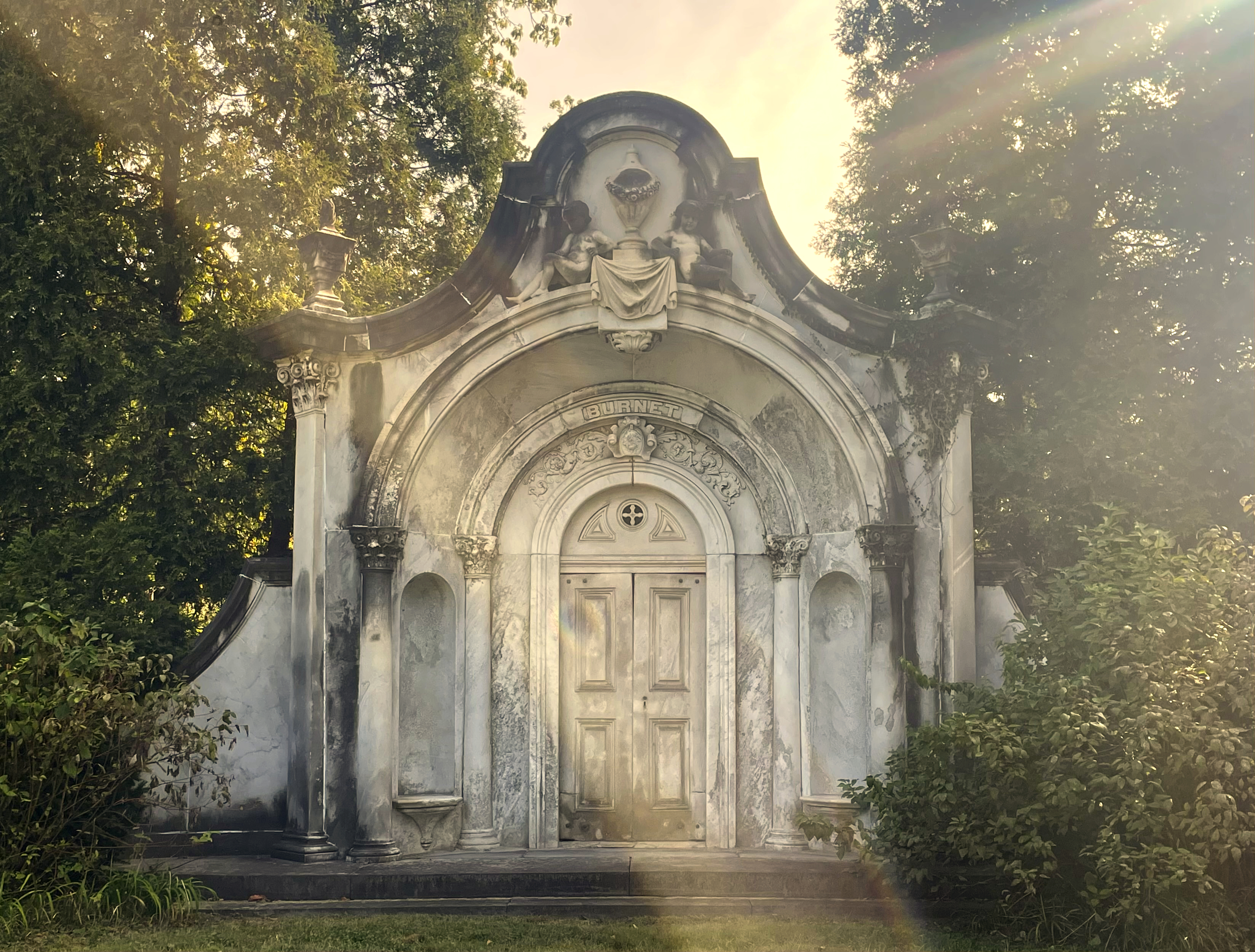
Landscapes can sometimes hold memories the way amber preserves an ancient insect—perfectly, timelessly. Spring Grove Cemetery is one such place—a 733-acre canvas where history, architecture, and human emotion intertwine like the roots of its century-old trees.
The morning was soft when I arrived with my friend, September’s gentle breath hovering between summer’s heat and autumn’s crisp promise. The entrance gate stood like a gothic sentinel, transforming the urban landscape into something entirely different. Wrought iron and stone marked our passage from the mundane world of traffic and schedules into a realm where time seemed to breathe more slowly.
This was not always a place of such deliberate beauty. In the 1830s and 1840s, Cincinnati suffered repeated cholera epidemics that decimated entire neighborhoods. Traditional burial grounds were little more than overcrowded, unsanitary plots, often segregated by religious denomination or social class. Founded in 1845 by Justus Scovill and Nicholas Longworth—prominent Cincinnati businessmen and horticulturists—Spring Grove emerged as a radical reimagining of how a community might honor its dead.
Longworth, in particular, was a visionary. A prominent winemaker and patron of the arts, he had traveled extensively in Europe and was deeply influenced by the pastoral cemeteries of Paris, particularly Père Lachaise. He envisioned a burial ground that was more than just a final resting place—a landscape that would serve as a public park, an arboretum, and a memorial to Cincinnati’s residents.
We began our journey into the cemetery by walking through a tunnel reminiscent of Central Park’s aged pathways, and we emerged to a fork in the road. Three roads diverged before us—left, right, forward - each promising its own narrative. We chose forward, a path alongside a pond where obelisks rose like stone sentinels, each marking a life, a story, a moment frozen in marble and memory.
The design was deliberate. Spring Grove was one of the first “rural cemeteries” in the United States, part of a movement that transformed how Americans approached death and remembrance. Unlike the cramped, utilitarian burial grounds of early 19th-century cities, it was conceived as a place of beauty, reflection, and natural wonder. The cemetery became a model for other urban green spaces, including New York’s Central Park.
In the distance, the Dexter Chapel Mausoleum stood—a gothic revival structure that seemed to whisper of Victorian-era mourning traditions. Its intricate stonework told stories of craftsmanship that predated mass production, each carved surface a testament to individual grief and collective memory. The chapel, designed by James Keyes Wilson in 1869, remains one of the most significant architectural features of the grounds.
Spring Grove is more than a cemetery—it’s an arboretum of international significance. The grounds host over 1,200 species of trees and shrubs, many of them rare or exotic. Landscape architects carefully planned each vista, each curve of the road, each placement of monument. The result was less a burial ground and more a public park where the living could contemplate mortality, nature, and history.
Our path wound around the lake, revealing glimpses of singular burial sites, family plots, and architectural variations that spoke to different eras of Cincinnati’s history. Notable residents found their final rest here, including several Civil War generals, prominent businessmen, and local philanthropists. The morning dew hadn’t yet burned away, leaving a soft sheen over the grounds. Leaves hinted at the coming autumn, not yet turned but promising transformation. A gentle breeze moved through the grounds, carrying with it the whispers of generations.
Our final path brought us to the section that would define the entire experience - the infant memorial. Balloons peeked above tiny markers, a heartbreaking testament to lives barely begun. Here, away from the grand mausoleums and historic markers, was raw human emotion. Walking through, something caught in my throat—a reminder that Spring Grove was more than a historical landmark. It was a place of profound human experience.
As a National Historic Landmark, Spring Grove represents more than just a burial ground. It is a living museum, an architectural archive, a botanical garden, and a memorial space all at once. In 1987, it was designated a National Historic Landmark, recognizing its significance in American landscape design, urban planning, and cultural history.
As we prepared to leave, the sounds of nearby streets slowly intruded - a reminder of the world continuing beyond these carefully tended acres. Spring Grove stood as a portal between memory and motion, between what was and what continues to be.
The Cincinnati Chamber of Commerce once quoted a visiting artist who said that Spring Grove was “a park more magnificent than any that exists for the living.” Standing there, watching light filter through ancient trees onto carefully placed monuments, I understood exactly what they meant.